
Tensile Mechanics in Elastomeric Polymer Manufacturing
Rubber products, medical nitrile gloves, and flexible seals undergo extreme physical stretching during operational use. Ensuring product integrity requires rigorous tensile elongation testing using Universal Testing Machines (UTM) equipped with specialized elastomeric grips.
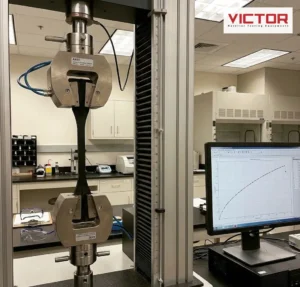
Why Do Manual Screw Grips Cause Errors in Rubber Tensile Testing?
Manual screw grips cause errors in rubber tensile testing because elastomeric materials experience severe lateral cross-sectional thinning under high strain, leading to sample slippage out of fixed manual jaws. As a vulcanized rubber dumbbell specimen stretches toward several hundred percent elongation, its cross-sectional area contracts drastically due to Poisson’s ratio effects. Manual screw grips maintain a constant mechanical jaw distance, allowing thinning rubber to slip. Self-tightening pneumatic wedge grips utilize constant air pressure to automatically increase clamping force as the sample thins, preventing slippage.
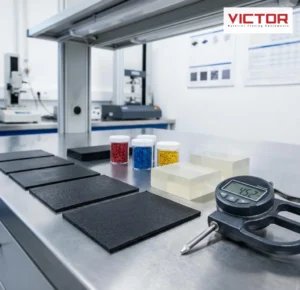
How Does Non-Contact Extensometry Improve Elongation Measurement Accuracy?
Non-Contact extensometry improves elongation measurement accuracy by tracking gauge marks optically without physically clamping heavy mechanical clips onto thin, delicate rubber specimens. Traditional clip-on mechanical extensometers add physical weight and sharp clamping edges that tear thin elastomeric films or cause premature specimen breakage at the clip point. Non-contact video or laser extensometers track optical gauge lines electronically, recording true material strain accurately up to eight hundred percent elongation.
Decision Matrix for Polymer Testing
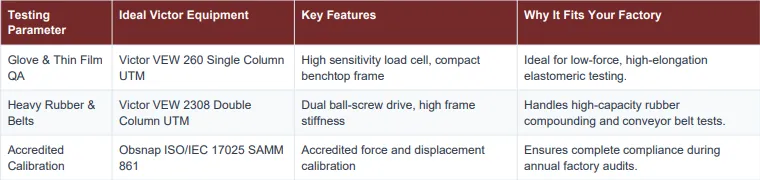
ASTM D412 Compliance & Factory Quality Assurance
Strict compliance with ASTM D412 and ISO 37 testing standards requires precision dumbbell specimen cutting using
sharp, un-nicked dies, controlled crosshead speeds, and accredited annual calibration. Partnering with Obsnap
Group provides complete hardware, testing software, and ISO/IEC 17025 accredited calibration support.