
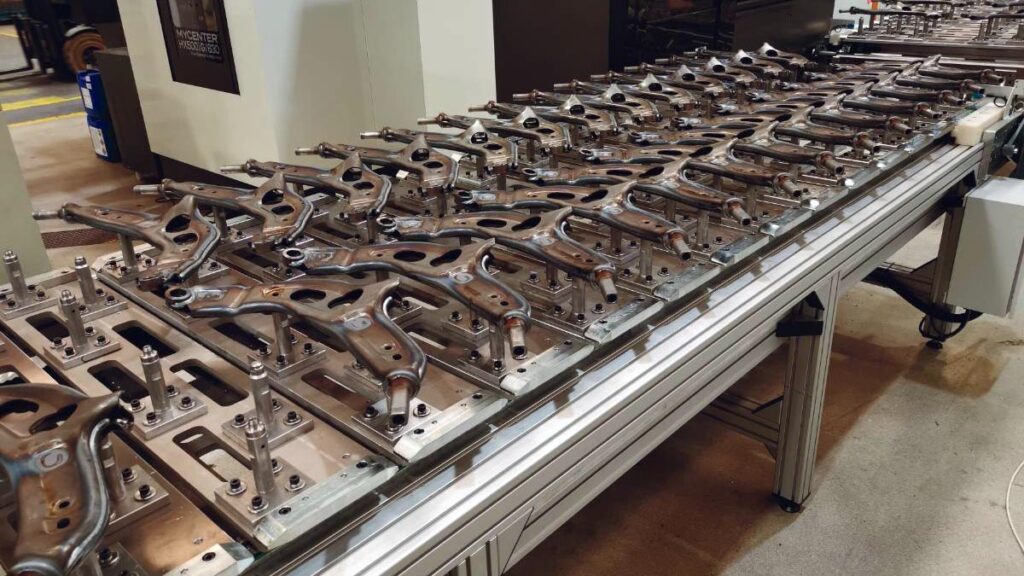
High-volume manufacturing requires fast output, stable quality, and consistent accuracy. As production increases, even minor delays or inconsistencies in inspection can create bottlenecks and increase costs. Many factories face this challenge when relying on manual measurement tools, which are slower, operator-dependent, and difficult to scale.
To solve this, manufacturers are increasingly adopting Automated Video Measurement Systems (Automated VMS). These systems combine non-contact optical measurement with CNC automation and intelligent software, making them ideal for high-volume environments where speed and precision must work together.
The Limitations of Manual Measurement
Traditional measurement tools such as calipers, micrometers, and projectors rely heavily on operator skill. While these tools are useful for small-scale production, they become less efficient in mass manufacturing.
Manual measurement causes challenges such as:
Slow cycle time for repeated measurements
Higher variation between operators
Increased fatigue during long shifts
Difficulty maintaining consistency across large batches
Higher manpower requirements as production volume increases
For industries where tens of thousands of parts must be verified daily, manual inspection becomes a major productivity barrier.
How Automated VMS Enhances Productivity
Automated VMS offers a structured, repeatable approach to dimensional inspection. Once measurement programs are created, the system can complete inspections with minimal operator input.
1. Faster Inspection Cycles
Automated VMS shortens inspection time significantly. CNC stages position the part, autofocus adjusts the image, and the system captures all required dimensions automatically. Measurements that once took minutes can now be completed in seconds.
This results in:
Fewer QC bottlenecks
Faster production approvals
Higher throughput, especially during peak cycles
2. Improved Repeatability and Accuracy
Because the system uses controlled lighting, fixed optics, and motorized movement, measurement variation is reduced. This ensures consistent results regardless of operator experience.
Manufacturers experience:
Better repeatability
Lower risk of measurement error
More stable tolerance control
3. Reduced Manpower Requirements
Operators only need to place the part and run the program. This simplifies training and allows companies to assign skilled inspectors to more complex tasks.
This contributes to:
Lower labor cost
Reduced training time
More efficient resource allocation
4. Better Process Control
Automated VMS collects measurement data throughout the day, allowing early detection of dimensional drift, tool wear, or process deviation.
This leads to:
Lower scrap and rework
Higher first-pass yield
Faster corrective action
Key Features That Support High-Volume Production
Automated VMS systems include several features designed for mass manufacturing.
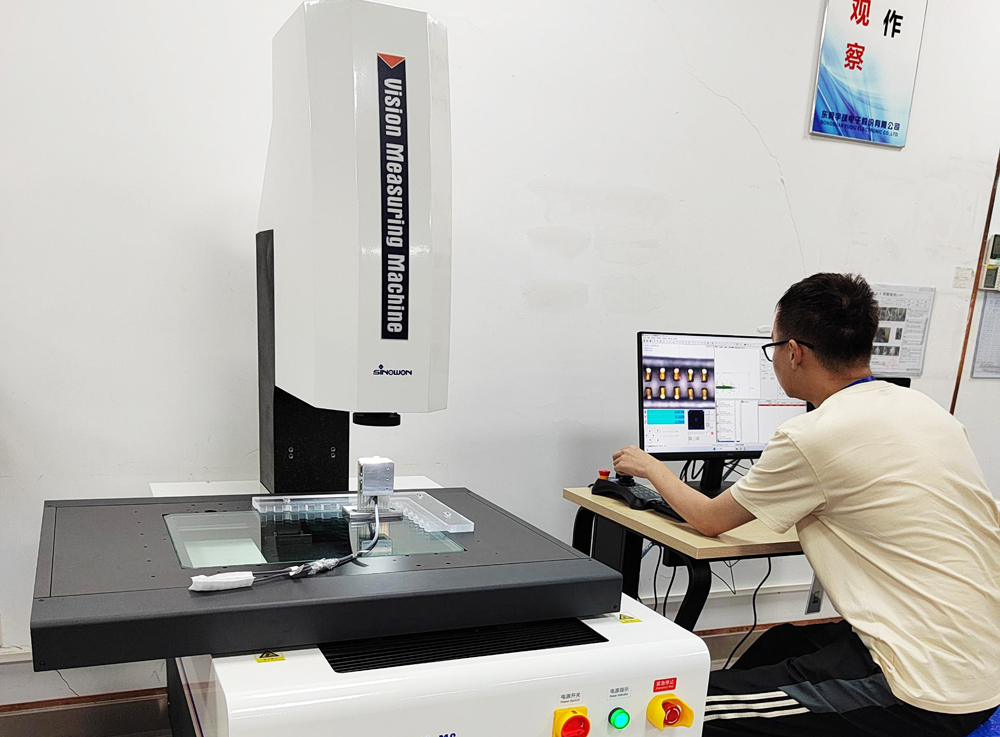
CNC Automated Stages
Motorized stages move the part precisely to each measurement location. This reduces handling time and eliminates alignment errors.
Programmed Measurement Sequences
Once a routine is created, it can be used for hundreds or thousands of identical parts. This stabilizes inspection quality across shifts.
Batch or Multi-Part Measurement
Multiple small components can be placed on the stage at once. The system automatically locates and measures each part.
This is especially useful for:
Connectors
Plastic caps
Molded components
Stamped metal parts
Applications Across High-Volume Industries
Automated VMS is widely used in industries where speed and accuracy are essential:
-
Automotive: fasteners, injection-molded parts, connectors
-
Electronics: PCB components, casings, micro parts
-
Medical: implants, disposable plastic parts, tubing
-
Consumer Products: closures, packaging items
-
Metalworking: CNC machined parts, stamped items, die-cast components
Each of these sectors benefits from fast, stable, and repeatable measurement processes.

Conclusion
Automated VMS has become a strategic tool for manufacturers operating in fast-paced, high-volume environments. By replacing manual inspection with automated measurement, factories gain faster cycle times, higher repeatability, and stronger control over product quality. This directly reduces scrap, rework, and labour dependency while supporting more stable production output.
Beyond accuracy, Automated VMS also strengthens overall process reliability. Its ability to handle complex geometries, generate instant digital reports, and maintain consistent inspection standards makes it suitable for industries where precision is non-negotiable. As product designs become more intricate and customer tolerances continue to tighten, the role of automated measurement will only grow more important.
For manufacturers aiming to stay competitive, adopting an Automated VMS system is not just an upgrade — it is a long-term investment in efficiency, quality, and operational stability.