
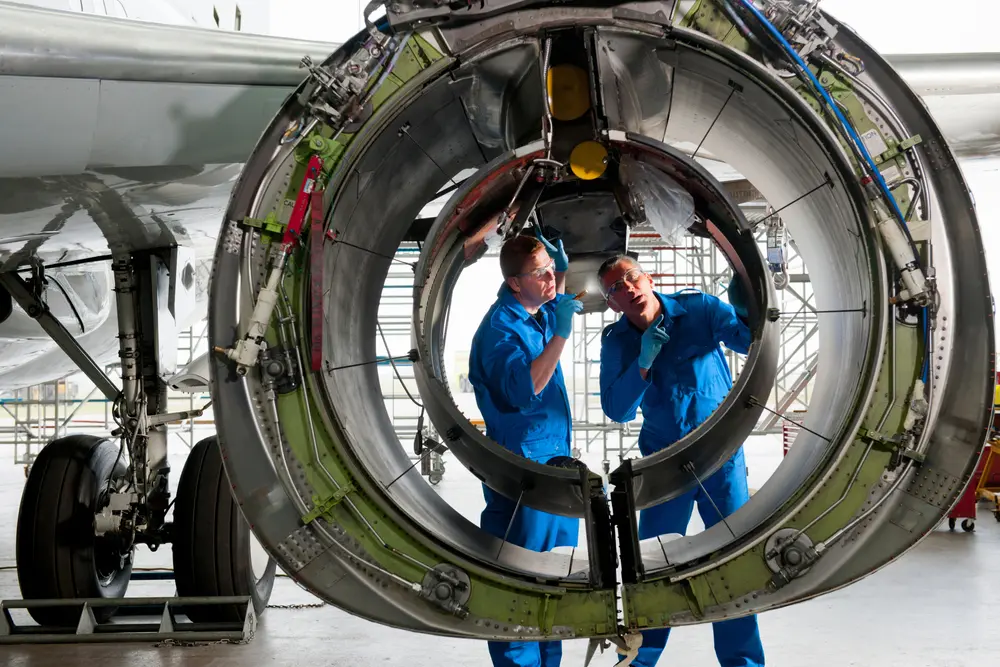
In the aerospace industry, precision is everything.
Each part from turbine blades to fuselage panels must operate flawlessly under extreme stress, pressure, and temperature.To achieve this, aerospace manufacturers depend on high-precision measurement systems such as Video Measuring Systems (VMS), Coordinate Measuring Machines (CMM), and 3D Scanners to verify accuracy down to the micrometer.
These technologies ensure that every manufactured component matches its design specifications, performs safely in operation, and complies with international standards such as AS9100, ISO 17025, and NADCAP.
In short, precision measurement isn’t just a step in aerospace production — it’s the foundation of reliability and trust.
What Is a High-Precision Measurement System?
A high-precision measurement system is a metrology tool designed to measure dimensions and geometries with extreme accuracy often within a few micrometers (μm).
These systems use optical, tactile, and laser-based sensors to capture accurate 2D and 3D data of aerospace components.
Common measurement systems used in aerospace manufacturing include:
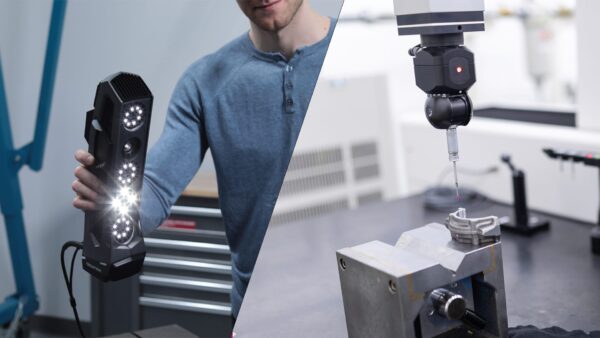
Coordinate Measuring Machines (CMM) – for tactile, high-accuracy 3D inspection
Video Measuring Systems (VMS) – for fast, non-contact optical measurement
3D Scanners – for full-surface digital capture and reverse engineering
Laser and Optical Profilers – for surface roughness and contour analysis
1. Precision and Safety Go Hand in Hand
In aerospace, precision equals safety.
Even a 0.05 mm dimensional error can cause serious imbalance or structural weakness.
For example:
Jet engine blades require uniform geometry for aerodynamic balance.
Landing gear components must align perfectly to handle heavy loads.
Fuselage panels must fit seamlessly to maintain pressure integrity.
High-precision systems such as CMMs, VMS, and 3D scanners capture these fine details with micron-level accuracy, ensuring total compliance with aerospace standards and reducing risk during flight.
2. Consistent, Repeatable, and Traceable Quality Control
Aerospace parts are often produced in large batches and consistency is critical.
High-precision measurement systems offer:
Repeatability: consistent results across operators and shifts.
Traceability: all data linked to calibrated standards for audits.
Automation: program-based inspection for minimal human error.
When inspecting turbine blades or structural brackets, a VMS captures 2D measurements, while a 3D scanner provides full-surface data.
These measurements are automatically compared to the CAD model, ensuring zero-defect manufacturing and faster quality validation.
3. Measuring Complex Geometries with Multi-Sensor Technology
Aerospace components often feature curves, contours, and intricate shapes that can’t be measured using simple tools.
Multi-sensor systems address this challenge by combining optical, tactile, and laser measurement technologies in one platform.
This approach allows engineers to:
Measure internal and external features accurately.
Capture curved surfaces, slots, and thin edges.
Perform full 3D inspection in a single setup.
For parts such as airfoils, titanium brackets, or composite panels, multi-sensor systems ensure complete dimensional coverage and eliminate the need for multiple inspection steps.
4. Real-Time Feedback for Smart Manufacturing
High-precision systems now play a central role in Industry 4.0 and smart manufacturing.
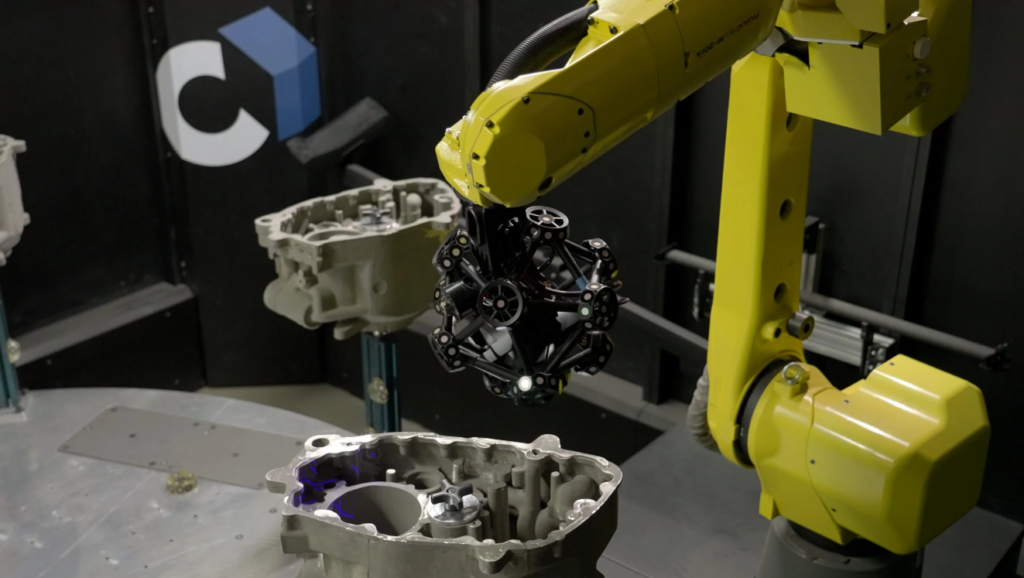
By integrating measurement data directly with CNC and CAD/CAM systems, aerospace manufacturers can achieve real-time process feedback.
This process known as closed-loop manufacturing works as follows:
- A CMM or 3D scanner detects dimensional deviation.
- The system sends data directly to the machine controller.
-
The CNC process automatically compensates for the next part.
The result is continuous production optimization, reduced downtime, and faster turnaround without compromising precision.
5. Adapting to Advanced Aerospace Materials
Today’s aerospace industry relies on lightweight composites, titanium alloys, and 3D-printed components.
Each material introduces new inspection challenges such as flexible surfaces, reflective coatings, and internal cavities.
Non-contact technologies like VMS and 3D scanners solve these challenges:
No physical contact means no damage to delicate materials.
Adaptive lighting and focus handle glossy or dark surfaces.
3D scanning captures entire geometries for additive-manufactured parts.
This allows manufacturers to confidently measure innovative materials and maintain the same level of precision and safety as with conventional metals.
6. Ensuring Compliance with Global Aerospace Standards
Aerospace manufacturing is governed by strict international standards such as:
AS9102 – First Article Inspection (FAI)
FAA / EASA – Aviation Authority Regulations
ISO 17025 – Testing and Calibration Competence
High-precision measurement systems simplify compliance through:
Automatic inspection reports
SPC (Statistical Process Control) documentation
Digital traceability and data logging
This automation saves time during audits and ensures every part meets the required documentation standards, building credibility with OEMs and regulators.

7. Reducing Production Costs and Scrap Rates
Although metrology systems are high-end investments, they deliver long-term cost efficiency by minimizing waste and rework.
Key advantages include:
30–50% shorter inspection times
Reduced material waste and rework
Higher first-pass yield
Less downtime during manufacturing
By catching defects early and preventing production drift, aerospace manufacturers maintain high throughput while ensuring perfect quality.
8. Building Trust with Aerospace Clients and OEMs
Global aerospace companies including Airbus, Boeing, and Rolls-Royce — depend on suppliers with strong quality assurance systems.
Using advanced metrology tools from trusted brands such as Hansvue, Obsnap, Zeiss, Mitutoyo, or Hexagon proves a supplier’s capability to deliver parts with verified dimensional accuracy.
Comprehensive measurement reports and traceable inspection data demonstrate professionalism, consistency, and reliability — all of which strengthen customer confidence and supplier partnerships.
9. The Future of Aerospace Metrology: Automation, AI, and Digital Twins
The next generation of aerospace metrology focuses on:
Automated robotic inspection
AI-driven feature recognition
Digital twin integration
Cloud-based data analytics
3D scanners and optical systems powered by AI will soon enable predictive quality control — identifying potential deviations before they occur.
This transformation will make aerospace manufacturing faster, smarter, and more sustainable.
Conclusion: Precision Builds Trust in the Sky
Every aerospace innovation from jet engines to satellites depends on one foundation: precision.
High-precision measurement systems such as CMMs, VMS, and 3D scanners ensure each component meets strict tolerances, safety standards, and performance goals.
They empower manufacturers to deliver reliable, traceable, and high-quality products trusted worldwide.
In an industry where every micron matters, precision measurement isn’t just technology it’s the guarantee that keeps aircraft flying safely and confidently.