
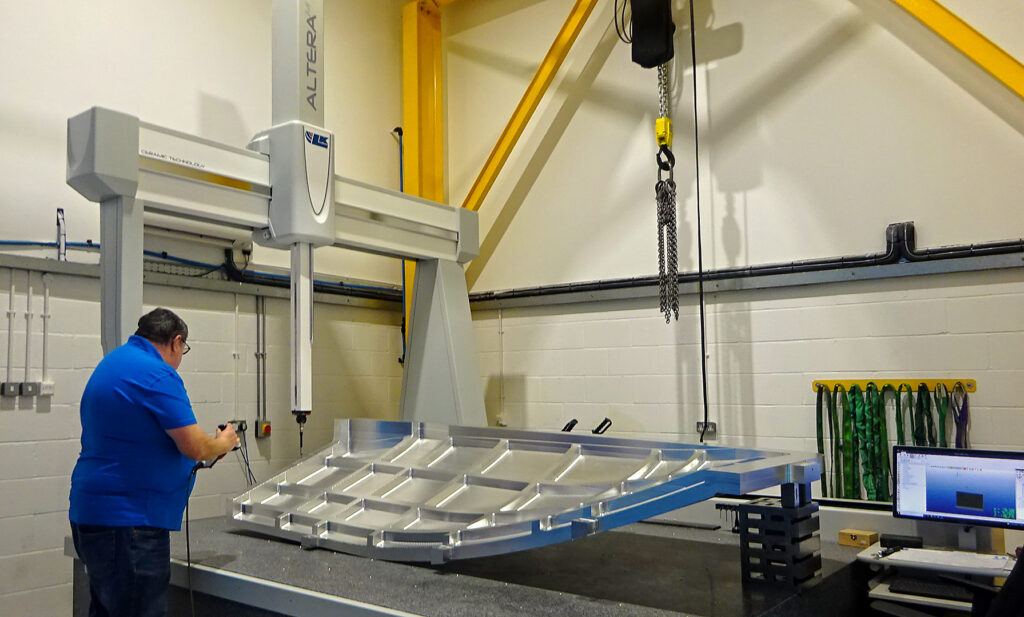
In high-precision industries like automotive and aerospace, quality control is not just a step in production it’s the foundation of safety, reliability, and brand reputation. Every part, no matter how small, must meet exact dimensional specifications. That’s why Coordinate Measuring Machines (CMMs) have become a critical part of modern manufacturing.
CMMs allow engineers and quality teams to confirm that each component matches its design precisely before it moves to assembly or shipment. This ensures that the final product performs safely and consistently in the real world.
What is a CMM?
A Coordinate Measuring Machine (CMM) is a precision tool used to measure the geometry of parts with high accuracy. It works by using a probe either touch or non-contact to capture key points on a component’s surface, which are then compared to design specifications or CAD data. CMMs come in different types like bridge, gantry, and portable arms, each suited for various part sizes and inspection needs.
In industries such as automotive and aerospace, CMMs play a major role in ensuring every part meets strict quality and safety standards. They help detect small dimensional errors, support reverse engineering, and generate detailed inspection reports automatically. This makes CMMs vital for maintaining consistent product quality and achieving precision in modern manufacturing.
CMM in the Automotive Industry: Ensuring Fit, Function, and Efficiency
Automotive manufacturers operate on mass-production scales where speed, accuracy, and consistency are everything. A single faulty part can affect thousands of vehicles and cost millions in recalls. CMMs play a vital role in preventing such problems.
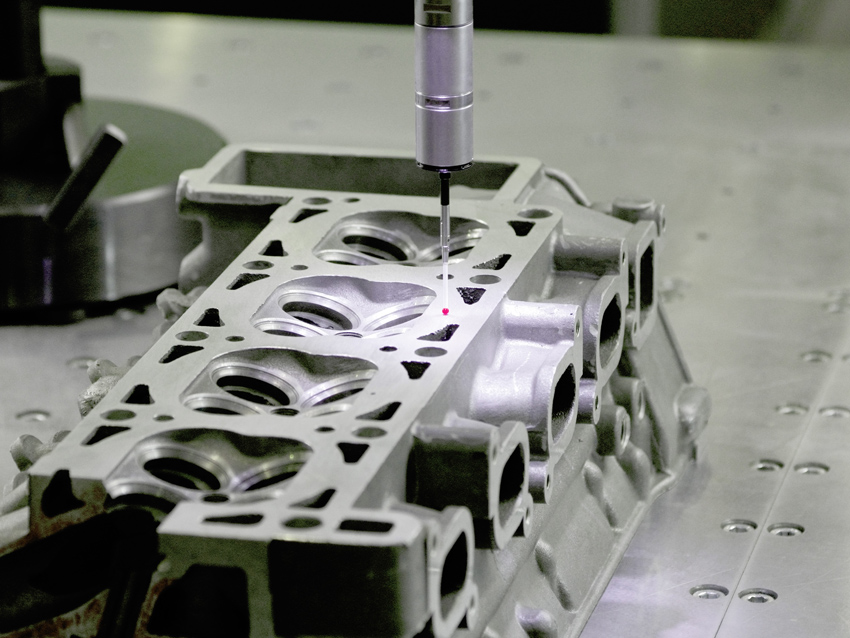
1. Dimensional Accuracy for Critical Components
Every part in a vehicle from the engine block to the gearbox, suspension arms, and dashboard components has to fit perfectly with others. CMMs inspect these parts to ensure all dimensions and tolerances meet design intent.
This prevents issues like vibration, misalignment, or excessive wear.
2. Supplier Quality Verification
Most automotive parts come from multiple suppliers. CMMs are used at both the supplier and OEM levels to verify part quality and maintain standardization. This guarantees that parts from different suppliers fit together seamlessly on the production line.
3. Assembly and Tooling Validation
CMM inspection is also used to validate assembly jigs, molds, and dies. If these tools are out of tolerance, it will affect every product made from them. Regular CMM checks ensure tooling accuracy and extend their lifespan.
4. First Article and In-Process Inspection
Before starting full production, CMMs are used for First Article Inspection (FAI) to verify that prototypes meet all dimensional requirements. During production, in-process measurement helps detect deviations early — reducing rework, scrap, and downtime.
5. EV and New Technology Applications
With the rise of electric vehicles (EVs), manufacturers use CMMs to inspect parts like battery casings, motor housings, and cooling systems, where tight tolerances are essential for safety and thermal performance.
CMM inspection helps ensure structural integrity and proper sealing of EV components.
6. Process Improvement and Data Feedback
CMM data is not just used for inspection but also for process feedback. By analyzing measurement results, engineers can identify the cause of dimensional errors whether it’s tool wear, fixture distortion, or material shrinkage — and correct it immediately.
This creates a closed-loop manufacturing system that improves efficiency and consistency.
CMM in the Aerospace Industry: Guaranteeing Safety and Compliance
In aerospace manufacturing, the margin for error is almost zero. Components must survive extreme pressure, heat, and vibration while maintaining perfect balance and strength. CMMs are essential in verifying that every part from turbine blades to fuselage panels meets exacting standards
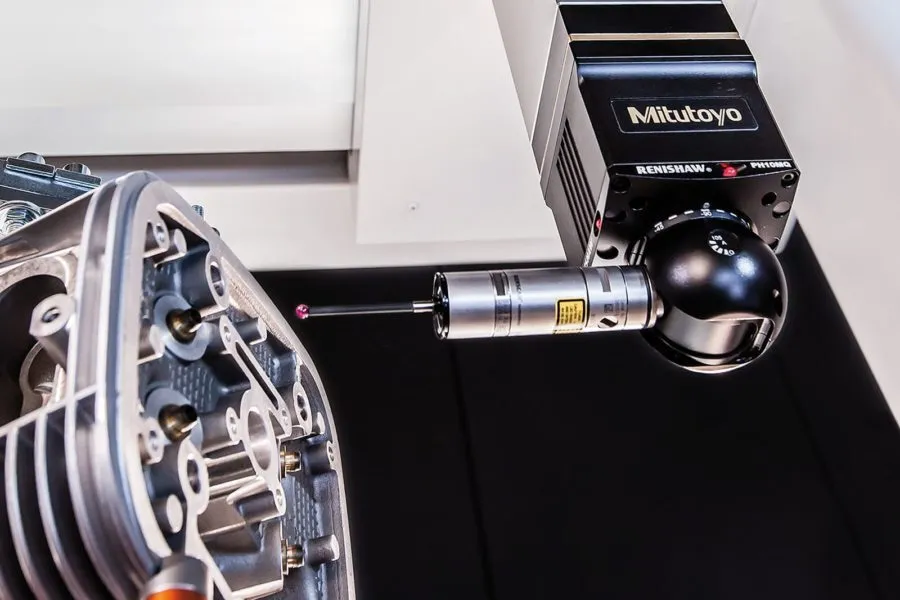
1. Inspection of Complex Geometries
Aerospace parts often feature curved, freeform surfaces that cannot be measured accurately with traditional gauges. CMMs, using high-precision probes or optical scanning, can capture complex 3D shapes and verify them against CAD models to micrometer precision.
2. Ensuring Airworthiness and Certification
Before an aircraft component is approved for flight, it must pass stringent dimensional and geometric tests. CMMs provide traceable data for FAI (First Article Inspection) and AS9100/NADCAP certification, ensuring compliance with aviation safety standards.
3. Large Component Inspection
For large assemblies like wings, fuselages, and landing gear, manufacturers use CMMs to verify alignment, hole positioning, and interface accuracy. Even a small deviation in hole spacing or surface flatness can affect aerodynamic performance or structural stability.
4. Lightweight Material Verification
The aerospace industry is moving toward composites and additive manufacturing (3D printing) to reduce weight. These materials are sensitive to temperature and shape changes, so CMMs are used to confirm their dimensions after curing or machining ensuring the final part remains within tolerance.
5. MRO (Maintenance, Repair, and Overhaul) Applications
CMMs are not only used in manufacturing but also in maintenance. During aircraft servicing, CMMs measure worn or damaged components to determine whether they can be repaired or must be replaced, supporting safe and cost-effective MRO operations.
How CMM Strengthens Quality Control Across Both Industries
Both the automotive and aerospace sectors share one critical goal zero defects. There Coordinate Measuring Machines (CMMs) play a central role. By integrating precision measurement into the design, production, and inspection process, CMMs ensure that every part produced matches its intended specification.
CMMs have become an essential part of modern quality management systems, supporting manufacturers in maintaining consistency, safety, and compliance. Their main contributions include:
Reducing human error: Automated measurement eliminates the inconsistency of manual inspection and ensures repeatable, reliable results every time.
Saving time: Fast scanning and automated routines significantly cut down inspection time compared to manual gauges or fixtures.
Improving traceability: Every measurement result is automatically stored and linked to digital records, supporting audit trails and certification documentation.
Enhancing productivity: Early detection of dimensional errors prevents defective parts from continuing down the production line, reducing rework and downtime.
Supporting Industry 4.0: CMMs are now connected to manufacturing networks and software, providing real-time data for process adjustment and continuous improvement.
Beyond inspection, CMMs are powerful data sources. When combined with Statistical Process Control (SPC)andCAD-based reporting, they give engineers complete visibility into production accuracy. The information collected helps identify process trends, tool wear, and potential failure points before they cause quality issues. This data-driven approach not only improves current production but also supports long-term quality stability and process optimization,
Conclusion
From the car factory to the aircraft hangar, CMMs have become the backbone of precision manufacturing. They help detect even the smallest dimensional errors before they cause costly failures.
In the automotive industry, CMMs ensure perfect part fit, reduce waste, and maintain supplier consistency.
In the aerospace sector, they guarantee the safety, performance, and certification of flight-critical components.
As manufacturing continues to evolve with automation and digital integration, CMMs remain a key quality tool bridging design and production to deliver safer, more reliable products for the world.